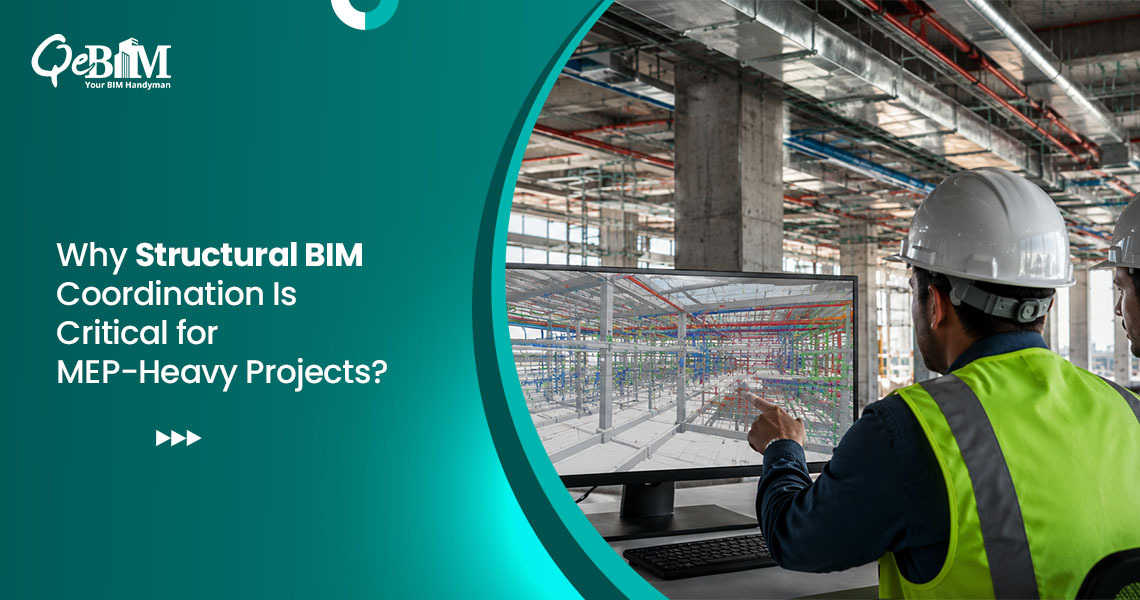
In today’s complex construction environment, structural and MEP systems are more interconnected than ever. High-rise buildings, hospitals, industrial facilities, airports and commercial developments often involves dense service layouts running through limited structural spaces. Without proper coordination, these overlapping systems can lead to severe clashes, costly rework, project delays and on-site confusion.
This is where Structural BIM Coordination becomes critical. By integrating the structural frameworks with mechanical, electrical and plumbing systems in a federated BIM environment, the project teams can proactively identify and resolve heavy clash zones before construction begins.
Understanding Heavy Clash Zones in BIM Projects
Heavy clash zones are areas within a building where multiple disciplines compete for the same physical space. These areas commonly include:
- Ceiling congested corridors
- Plant rooms and mechanical floors
- Shaft openings and risers
- Basement utility areas
- Structural beam intersections
- HVAC duct crossings with structural framing
- High-density MEP service routes
In traditional 2D workflows, these conflicts are often discovered only during installation. However, BIM coordination allows the teams to detect these issues digitally at the design stage.
Why Structural and MEP Coordination Is Challenging?
Structural systems are designed to provide stability and load-bearing capacity, while MEP systems requires flexibility for routing services efficiently.
The challenge arises when:
- Large ducts pass through the structural beams
- Pipe slopes interfere with slab depths
- Cable trays conflict with ceiling clearances
- Structural braces obstruct HVAC routing
- Equipment maintenance zones overlap with framing systems
In complex buildings, even a minor coordination issue can impact multiple disciplines simultaneously.
The Role of BIM in Clash Management
BIM enables all project stakeholders to work within a coordinated 3D environment. Structural engineers, MEP consultants, architects and contractors can collaborate using federated models to analyze spatial relationships accurately.
Using advanced coordination workflows, BIM teams can:
- Detect hard clashes and soft clashes
- Validate clearances and maintenance access
- Optimize routing paths
- Reduce structural penetrations
- Improve constructability
- Minimize site-level improvisation
This coordinated approach significantly reduces RFIs, reworks and installation delays.
Types of Clashes in Heavy Coordination Zones
- Hard Clashes
These occurs when two physical components occupy the same space.
Example:
An HVAC duct conflicting with the structural beam layout.
- Soft Clashes
These involves clearance or accessibility violations rather than just the direct intersections.
Example:
Insufficient maintenance space around electrical panels or AHU units.
- Workflow Clashes
These are sequencing or installation-related conflicts.
Example:
Steel framing installed before the large prefabricated ducts are lifted into position.
Key Strategies for Managing Heavy Clash Zones
- Early Coordination During Design Development
The earlier coordination begins, the easier it becomes to solve the conflicts cost-effectively. Waiting until the construction phase often results in redesigns and schedule impacts.
Integrated BIM workflows during schematic and design development stages helps to establish:
- Service hierarchy
- Routing priorities
- Structural opening requirements
- Ceiling zone allocations
- Defining Discipline Priorities
Successful coordination depends on establishing routing priorities among disciplines.
A typical hierarchy may include:
- Structural elements
- Fire protection systems
- Large HVAC ducts
- Plumbing systems
- Electrical containment
This structured approach reduces unnecessary redesign cycles.
- Using LOD-Based Coordination
Different Levels of Development (LOD) improve coordination accuracy throughout project phases.
- LOD 200: Conceptual coordination
- LOD 300: Accurate spatial coordination
- LOD 350: Connection and interface detailing
- LOD 400: Fabrication-ready coordination
Higher LOD models are especially important in congested plant rooms and service corridors.
- Coordinated Structural Openings
One of the biggest issues in the construction projects occurs when the MEP teams create unplanned penetrations in slabs or beams onsite.
BIM coordination helps identify:
- Sleeve locations
- Beam openings
- Shaft penetrations
- Embedded supports
This ensures structural integrity while maintaining efficient service routing.
- Automated Clash Detection Tools
Modern BIM platforms use automated clash detection to identify coordination issues quickly.
Commonly used platforms includes:
- Autodesk Navisworks
- Revit
- Solibri
- BIM 360
- Tekla Structures
These tools generates clash reports categorized by severity, discipline and constructability impact.
Real-World Example: Hospital Coordination Challenges
Hospitals are among the most coordination-intensive building types due to dense MEP infrastructure.
A single operating floor may include:
- Medical gas pipelines
- HVAC systems with strict airflow requirements
- Electrical containment
- Fire protection networks
- Structural framing
- Specialized medical equipment supports
In one healthcare project, BIM coordination identified over 4,000 clashes before construction. By resolving these digitally, the contractor reduced onsite reworks significantly and improved installation sequencing.
Industrial Facilities and Heavy Clash Management
Industrial plants and manufacturing facilities face even greater coordination complexity.
Large process pipes, cable trays, steel platforms and heavy equipment foundations creates highly congested environments. In these projects, coordinated BIM workflows help teams to:
- Optimize pipe routing
- Prevents steel interference
- Improves equipment accessibility
- Reduces shutdown risks during installation
- Supports prefabrication strategies
This is where accurate MEP BIM Services plays a vital role in ensuring the seamless coordination between the engineering disciplines.
The Importance of Structural Modeling Accuracy
Clash coordination is only as reliable as the quality of the models involved. Inaccurate beam depths, missing connections or incomplete framing data can lead to false clash results.
High-quality Structutal Modeling Services helps teams to create reliable digital representations that improves coordination precision, fabrication readiness and onsite execution.
Benefits of Effective Structural-MEP Coordination
Organizations implementing coordinated BIM workflows experience several advantages:
- Reduced construction reworks
- Faster project delivery
- Improved installation accuracy
- Better prefabrication opportunities
- Lower material wastage
- Enhanced site safety
- Improved communication among stakeholders
- Greater cost predictability
According to industry studies, coordinated BIM processes can reduce coordination-related rework costs by up to 40% in complex projects.
Future Trends in Clash Coordination
The future of BIM coordination is moving towards intelligent automation and predictive analysis.
Emerging technologies includes:
- AI-assisted clash prioritization
- Real-time cloud coordination
- Digital twin integration
- Automated routing optimization
- AR/VR-based onsite clash visualization
As projects continue to grow in complexity, digital coordination will become even more essential for efficient project delivery.
Conclusion
Heavy clash zones are inevitable in modern construction projects, especially in highly serviced and structurally dense environments. However, with coordinated BIM workflows, teams can detect, analyze and resolve conflicts long before the construction begins.
Effective coordination between the structural and MEP systems improves constructability, reduces costly reworks and enhances the overall project efficiency.
As BIM technologies continue to evolve, integrated coordination strategies will remain central to delivering smarter, faster and more reliable construction outcomes.