Introduction
Construction projects today are becoming increasingly complex, involving multiple disciplines, tighter schedules and higher expectations for accuracy. Yet, one challenge continues to affect project delivery across the industry—discrepancies between coordinated BIM models and construction documentation.
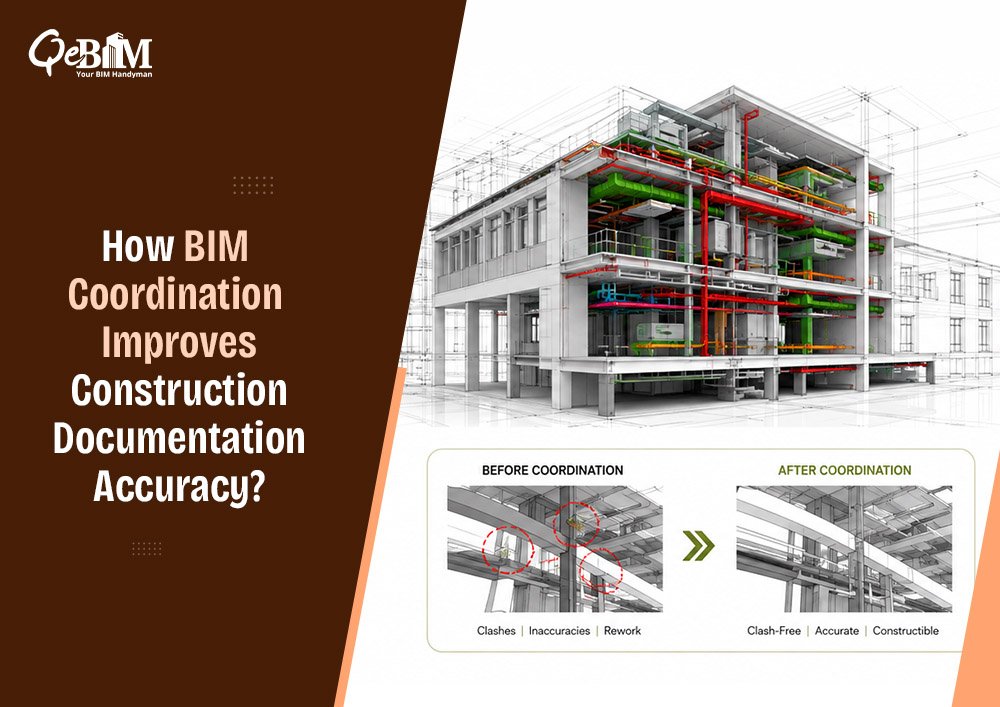
Even when the project teams invest significant effort in model coordination, clashes often reappear during the construction because design updates are not consistently reflected in the final drawing set. This disconnect can lead to rework, RFIs, project delays and costly on-site conflicts.
To overcome this challenge, forward-thinking firms are adopting workflows that directly links the construction documentation with BIM coordination processes. By integrating coordinated models into the documentation development, teams can produce clash-free drawings that improves the project execution and reduce the construction risks.
The Traditional Gap Between Coordination and Documentation
Historically, BIM coordination and construction documentation have often been treated as separate activities.
The typical workflow involves:
- Creating discipline-specific BIM models
- Performing clash detection and coordination reviews
- Resolving conflicts between architectural, structural as well as the MEP systems
- Generating construction drawings independently
While clashes may be resolved within the model environment, documentation can quickly become outdated when changes are not synchronized across all the drawing sheets and disciplines.
As projects progress through design revisions, manual updates increase the likelihood of:
- Inconsistent drawings
- Missing coordination changes
- Incorrect dimensions and locations
- Conflicting installation information
- Construction field issues
The result is a set of drawings that no longer accurately represents the coordinated project model.
Why Linking Construction Documents with BIM Coordination Matters?
Construction documents are the initial information used by the contractors, fabricators and site teams. Therefore, their accuracy directly impacts the project outcomes.
When construction documentation is generated directly from the coordinated BIM models, teams gain access to a single source of truth throughout the project lifecycle.
This approach ensures:
Improved Design Consistency
Any approved coordination changes are immediately reflected in the associated views, sections, elevations and schedules.
Reduced Reworks
Contractors receive drawings based on the coordinated information, minimizing field modifications and installation conflicts.
Faster Decision-Making
Project stakeholders can review the coordinated models and associated documentation simultaneously thus improving the communication and approvals.
Better Construction Sequencing
Accurate documentation supports prefabrication, procurement and installation planning.
Enhanced Quality Control
Drawing reviews become more efficient because the documentation is continuously validated against the coordinated model.
The Importance of BIM Coordination in Clash-Free Documentation
Effective BIM Coordination Services serve as the foundation for reliable construction documentation.
Coordination processes typically involves:
- Federating multidisciplinary models
- Running clash detection analyses
- Prioritizing and resolving conflicts
- Conducting coordination meetings
- Tracking issue resolution
- Updating discipline models
Once clashes are resolved, the coordinated model becomes the authoritative project dataset from which documentation can be generated.
This ensures that every drawing sheet reflects validated design information rather than just the isolated discipline-specific updates.
How BIM-Driven Documentation Works?
A BIM-enabled documentation workflow creates a direct connection between model coordination and drawing production.
Step 1: Model Development
Architectural, structural, and MEP models are developed to the needed LOD.
Step 2: Clash Detection
Coordination software identifies the conflicts between the different building components before the construction.
Step 3: Issue Resolution
Project teams review and resolve clashes through collaborative coordination sessions.
Step 4: Model Validation
The coordinated model is verified for constructability, accessibility, and compliance requirements.
Step 5: Drawing Generation
Construction drawings are generated directly from the approved coordinated model.
Step 6: Continuous Updates
Any approved design changes are automatically reflected across all related views and construction documentation
This process significantly reduces the risk of discrepancies between model data and drawing deliverables.
Benefits for Contractors and Project Owners
Linking construction documentation directly with BIM coordination delivers measurable advantages throughout project execution.
Fewer RFIs
Accurate drawings reduce ambiguity and minimize requests for clarification from contractors.
Reduced Construction Delays
Early clash resolution prevents disruptions caused by field conflicts.
Better Cost Control
Avoiding rework and design conflicts helps maintain project budgets.
Improved Installation Accuracy
Trade contractors can confidently rely on coordinated drawings for fabrication and installation.
Higher Project Quality
Consistent information improves overall construction quality and client satisfaction.
Supporting Prefabrication and Modular Construction
The importance of clash-free documentation becomes even greater in prefabrication and modular construction environments.
Manufactured components require precise dimensions and coordination. Even minor discrepancies between drawings and models can result in fabrication errors, delivery delays, and installation issues.
By generating documentation directly from coordinated BIM models, project teams can support:
- Off-site fabrication
- MEP prefabrication
- Modular assemblies
- Shop drawing development
- Digital construction workflows
This level of accuracy is becoming essential as industrialized construction methods continue to gain adoption worldwide.
Best Practices for Achieving Clash-Free Documentation
Organizations seeking to improve project coordination should consider the following best practices:
- Establish coordination standards early in the project.
- Define clear model ownership responsibilities.
- Maintain a common data environment (CDE).
- Conduct regular clash detection reviews.
- Synchronize model updates across all disciplines.
- Generate documentation directly from coordinated models.
- Apply robust quality assurance and quality control.
- Track design changes throughout the project lifecycle.
These practices help ensure that construction documents remain aligned with project coordination efforts.
Conclusion
As construction projects become more complex, the separation between BIM coordination and documentation is no longer sustainable. Organizations that connect coordinated models directly to drawing production can significantly reduce errors, improve constructability, and streamline project delivery.
Modern Construction Drawing Services are increasingly dependent on coordinated BIM workflows that provide accurate, up-to-date project information. By establishing a direct link between BIM coordination and documentation, project teams can create clash-free drawings that improve collaboration, reduce risk, and support successful construction outcomes.
In an industry where accuracy directly impacts cost, schedule, and quality, integrated BIM-driven documentation is rapidly becoming a critical component of efficient project delivery.