Introduction
The AEC industry is rapidly evolving with the adoption of digital technologies that enhances efficiency, collaboration and project outcomes. Two of the most impactful methodologies driving this transformation are BIM and VDC. Although frequently used interchangeably, they represent distinct concepts.
Understanding the distinction and more importantly, how they complement each other—is critical for the project stakeholders aiming to optimize design, coordination and execution. In this blog, we explore the relationship between the VDC and BIM, their individual roles and how their integration delivers measurable values across the project lifecycle.
What is BIM?
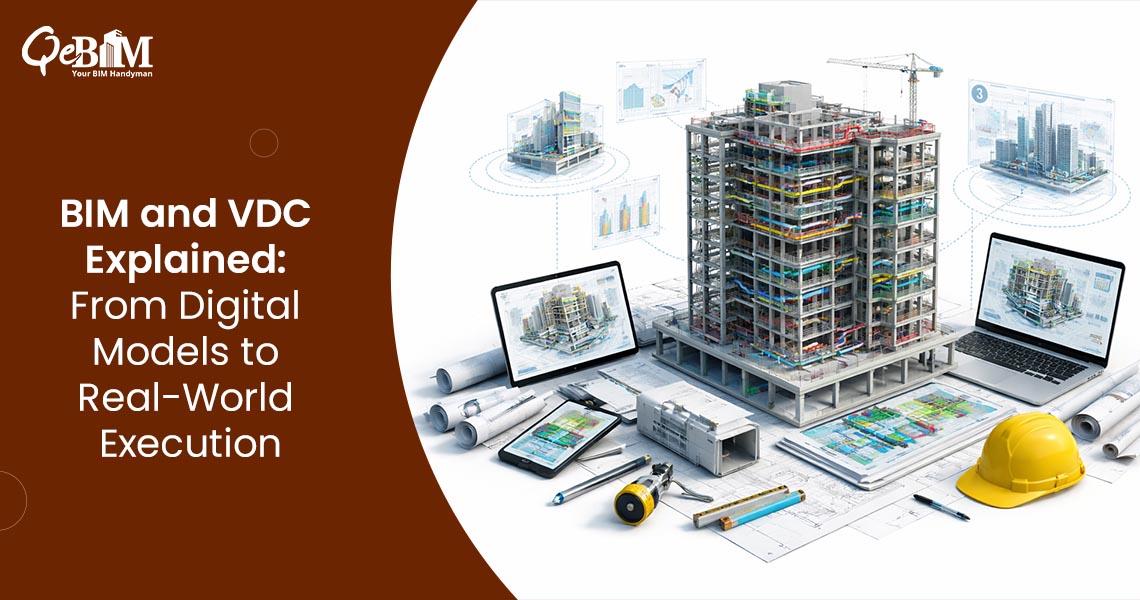
BIM is a digital illustration of a building’s physical and operational data. It is not just a 3D model but a data-rich environment that integrates geometry, spatial relationships, material specifications, cost and scheduling information.
Key Features of BIM:
- Intelligent 3D modeling with embedded data
- Multi-disciplinary collaboration
- Clash detection and coordination
- 4D (time) and 5D (cost) integration
- Lifecycle data management
BIM serves as the foundation for digital construction thus enabling the stakeholders to make informed decisions based on accurate and real-time data.
What is VDC?
VDC is a broader framework that uses the digital tools, including BIM, to simulate and optimize the construction processes before the actual execution. Developed by Stanford University Center for Integrated Facility Engineering, VDC focuses on integrating people, processes and technology.
Core Components of VDC:
- Product: The building model (often created using BIM)
- Process: Construction sequencing and workflows
- Organization: Team collaboration structures
Key Capabilities of VDC:
- Construction simulation and planning
- Risk mitigation through virtual prototyping
- Lean construction integration
- Real-time performance tracking
- Enhanced stakeholder collaboration
In essence, VDC leverages the BIM data but extends beyond the design into construction strategy and execution.
VDC vs BIM: Key Differences
| Aspect | BIM | VDC |
| Definition | Digital modeling process | Project delivery framework |
| Focus | Design and data modeling | Process optimization and execution |
| Scope | Design & documentation | Design + construction + operations |
| Technology | Software-driven | Methodology using multiple tools |
| Outcome | Accurate digital model | Efficient project delivery |
How VDC and BIM Work Together?
Rather than competing approaches, BIM and VDC are complementary. BIM acts as the data engine, while VDC is the strategic framework that uses this data to drive the project success.
- BIM Enables VDC Workflows
VDC relies heavily on the BIM models for simulation and analysis. Without accurate BIM data, VDC processes such as scheduling and cost estimation would lack precision.
- Enhanced Visualization & Simulation
BIM provides 3D models, while VDC transforms them into:
- 4D simulations (construction timelines)
- 5D simulations (cost implications)
- Scenario-based planning
- Improved Collaboration
BIM centralizes the project data and VDC ensures that this data is used effectively across the teams thus reducing the miscommunication and enabling faster decision-making.
Proven Impact: Case Studies & Industry Data
The true value of BIM and VDC integration is reflected in the real-world performance improvements across projects.
- Quantifiable Industry Benefits
Studies indicates that projects leveraging BIM with VDC achieve:
- Up to 37% improvement in project efficiency
- 34% reduction in construction risks
- 24% decrease in material waste
- 21% better communication across stakeholders
- 26% increase in prefabrication efficiency
These figures demonstrates how BIM provides the reliable data while VDC ensures its effective execution.
- Case Study: Mortenson Construction (US based Construction Firm)
Across multiple large-scale projects:
- Over 600 days of cumulative schedule savings
- Approximately 3% direct cost reduction
- Noticeable improvements in safety and productivity
Insight:
VDC-driven planning, powered by BIM data, significantly compresses the timelines and enhances the project predictability.
- Large-Scale Multi-Building Project
In a $240 million development involving 8 buildings and 30+ stakeholders:
- BIM-enabled VDC workflows improved coordination
- 4D simulations enabled better scheduling decisions
- Teams relied on a single, accurate digital model
Insight:
This highlights how BIM acts as the single source of truth, while VDC transforms it into actionable strategies.
- Healthcare Infrastructure Projects
Projects using BIM with VDC reported:
- 74% reduction in RFIs during foundation stages
- 47% reduction during the structural phases
- Up to 66% faster coordination timelines
Insight:
Fewer RFIs means fewer delays, smoother workflows and better collaboration.
Benefits of Integrating VDC and BIM
- Reduced reworks through early issue detection
- Faster project delivery timelines
- Optimized resource utilization
- Improved construction quality
- Enhanced risk management
For organizations offering Architectural BIM Services, integrating VDC methodologies ensures not just better design—but smarter execution.
Industry Trends & Future Outlook
- BIM adoption has reached over 70% in developed markets
- Increasing demand for the digital construction workflows
- Up to 30% reduction in lifecycle carbon emissions using BIM-driven planning
As the digital transformation accelerates, VDC + BIM integration is becoming the industry standard.
Choosing the Right Approach
A forward-thinking BIM Company does not treat BIM as a standalone solution. Instead, it integrates BIM within a VDC framework to deliver:
- End-to-end project visibility
- Data-driven planning and execution
- Improved ROI and client satisfaction
Conclusion
BIM and VDC are not competing technologies—they are deeply interconnected. BIM provides the digital backbone of project information, while VDC transforms that information into actionable insights for the construction and delivery.
United, they drive a smarter, efficient and highly collaborative construction ecosystem. As the AEC industry continues to evolve, organizations that effectively combine BIM and VDC will lead the way in delivering high-performance, cost-effective and future-ready projects.