A building’s operational life can span decades, yet the information required to operate it is often fragmented immediately after the handover. As-built drawings may sit in document repositories, equipment schedules in spreadsheets, maintenance records in separate systems and live building data inside a Building Management System (BMS).
This creates a familiar problem for facility teams: the building exists physically, but its information is scattered digitally.
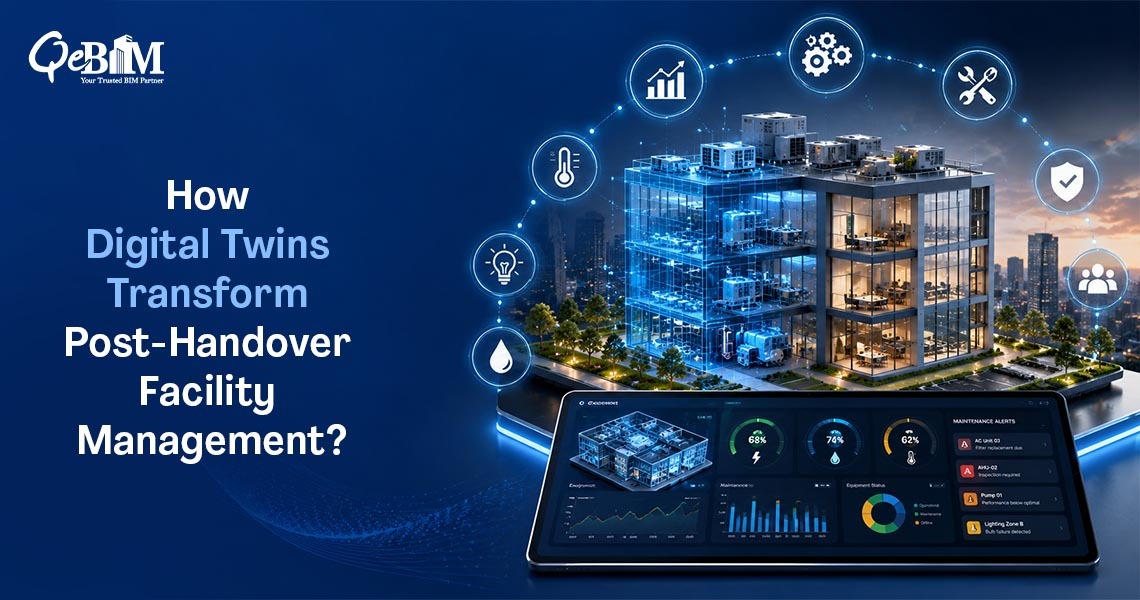
Digital twins are changing this model by connecting the physical asset with a continuously updated digital representation. When properly implemented, a digital twin can combine BIM geometry, asset metadata, sensor feeds, maintenance history, equipment specifications and operational performance into a common environment.
The result is not merely better visualization. It is a more informed approach to operating, maintaining and optimizing buildings after handover.
From BIM Handover to Operational Intelligence
A conventional BIM handover typically provides an as-built representation of the completed facility. It can contain information about spaces, equipment, systems, materials and components.
A digital twin takes this information further.
It establishes relationships between the digital model and the physical asset thus allowing the operational information to be associated with the specific building elements. For example, an AHU represented in the model can be connected to its manufacturer information, asset ID, maintenance schedule, temperature sensors, energy consumption, service history and current operating condition.
This distinction is important.
An as-built model documents what was constructed. A digital twin helps to understand how that asset is operating.
ISO 19650-3 specifically addresses this information management during the operational phase of the built assets, demonstrating that the structured information management does not end at project delivery.
- Faster Access to Asset Information
Facility managers frequently needs answers to seemingly simple questions:
- Where is a particular piece of equipment located?
- What system does it serve?
- When was it installed?
- What is its maintenance history?
- What are its operating parameters?
- Which replacement components are required?
Without an integrated information environment, answering these questions can involve searching through drawings, spreadsheets, manuals, work orders and databases.
A digital twin provides spatial context around this information.
Selecting an asset within the digital environment can potentially reveal its specifications, location, associated systems, maintenance requirements and historical records.
This reduces information retrieval time and gives technicians a more complete understanding of the asset before they begin physical work.
- More Proactive Maintenance
One of the strongest applications of the digital twins are the transition from the reactive to predictive maintenance.
Traditional maintenance strategies often rely on fixed schedules—for example, servicing equipment every six months regardless of its actual operating condition.
Digital twins can combine asset history with real-time or near-real-time operational data.
Consider an HVAC system. Temperature, pressure, vibration, runtime, airflow and energy-consumption data can be associated with the equipment represented within the digital environment. Analytics can then identify the abnormal patterns that may indicate degradation.
Instead of just waiting for the equipment malfunction, the facility team can investigate the deviations and schedule the maintenance earlier.
This can help reduce:
- Unexpected equipment failures
- Emergency maintenance
- Operational disruption
- Unplanned downtime
- Premature component replacement
Research into digital-twin-enabled facility management similarly highlights the value of integrating BIM, equipment metadata and IoT data to support the preventive and reactive maintenance workflows.
- Improved MEP System Visibility
Modern facilities contains highly interconnected mechanical, electrical and plumbing systems.
A failure in one component can affect multiple systems. For example, an HVAC failure may influence temperature control, occupant comfort, energy consumption and even equipment performance in adjacent spaces.
A digital twin provides a systems-level view.
Instead of viewing an individual asset in isolation, facility teams can understand the relationships such as:
Equipment → System → Zone → Space → Building
This context becomes particularly valuable in complex facilities such as hospitals, airports, manufacturing plants, data centers and large commercial buildings.
For example, before replacing a pump, a technician can examine its connected piping, valves, equipment, access requirements and surrounding services digitally. This reduces dependence on the outdated drawings and improves planning before the work begins.
- Better Energy and Performance Management
Building operations accounts for a significant portion of a facility’s lifecycle impact, making operational performance an important focus after handover.
Digital twins can bring together information from:
- Smart meters
- HVAC sensors
- Lighting systems
- Occupancy sensors
- BMS platforms
- Environmental sensors
- Equipment monitoring systems
This creates a foundation for comparing expected and actual performance.
For example, if two similar zones have significantly different energy consumption, facility managers can investigate the occupancy, temperature settings, equipment performance, operating schedules or control-system behaviour.
The digital twin therefore becomes a platform for performance analysis rather than just simply asset visualization.
- Supporting Space and Occupancy Management
Facility management extends far beyond the equipment maintenance.
Organizations also needs to understand how their spaces are being used.
A connected digital environment can combine spatial information with occupancy and utilization data to help facility teams to identify the underutilized areas, changing space requirements and opportunities for consolidation or reconfiguration.
For large organizations, this can support decisions about:
- Workspace planning
- Department relocation
- Meeting-room utilization
- Space allocation
- Asset placement
- Future refurbishment
The BIM model provides the spatial structure, while operational data adds the behavioural context.
- Safer and More Efficient Maintenance Work
Digital twins can also improve the maintenance planning by giving technicians access to the spatial and system information before entering a work area.
A technician investigating a ceiling-mounted HVAC component, for example, can review its digital location, surrounding services, access constraints, equipment specifications and associated systems before arriving on site.
For complex facilities, this can support:
- Maintenance planning
- Isolation planning
- Access coordination
- Safety assessments
- Work sequencing
- Technician training
The value increases when the digital environment incorporates the accurate as-built information rather than just relying solely on the design intent.
- Better Handover and Lifecycle Information Management
A major challenge in BIM-enabled projects is maintaining the information continuity between the design, construction, commissioning and operations.
The handover should not represent the end of the information workflow.
The information produced during design and construction should be structured so that relevant data can continue to support operational requirements.
ISO 19650 establishes the information-management principles across the asset lifecycle, while Part 3 specifically focuses on the operational phase.
This means digital-twin implementation should ideally begin with the operational requirements rather than just being added as a technology layer after construction.
What Does a Digital Twin Need After Handover?
A useful digital twin does not necessarily require every possible data source.
Its value relies totally on the quality and relevance of the information connected to it.
A practical implementation may include:
BIM Model
→ Geometry, spaces, systems, asset relationships
Asset Information
→ Manufacturer, model, serial number, specifications, warranty
Operational Data
→ Sensors, BMS, meters, equipment performance
Maintenance Data
→ Inspections, work orders, service history
Documentation
→ O&M manuals, certificates, drawings, commissioning records
Analytics
→ Performance monitoring, anomaly detection, predictive insights
Visualization Layer
→ 3D environment, dashboards, asset search and system relationships
The key is interoperability. If BIM, CAFM, CMMS, BMS, IoT and document-management platforms operate as isolated information silos, simply adding a 3D viewer does not create a meaningful digital twin.
The Critical Challenge: Data Quality
The biggest misconception is that a digital twin is primarily a modeling exercise.
It is not.
A highly detailed BIM model with inaccurate asset information can be less valuable than a simpler model containing reliable operational data.
Before implementation, organizations should establish:
- Asset naming conventions
- Unique asset identifiers
- Required information fields
- Data ownership
- Update responsibilities
- Information exchange requirements
- Model maintenance procedures
- Integration standards
- Cybersecurity and access controls
The digital twin must also evolve as the physical asset changes. Renovations, equipment replacements, space modifications and system upgrades needs to be reflected in the digital environment.
Otherwise, the twin gradually becomes another outdated information repository.
Where BIM Companies Fit Into the Digital Twin Workflow?
The transition from BIM to a digital twin involves more than simply integrating different software platforms. It requires accurate asset information, structured models, discipline coordination, data validation and an understanding of how buildings operates.
This is where a specialized BIM Company can contribute beyond traditional modeling.
Its role can include developing asset-rich as-built models, integrating equipment metadata, validating spatial information, preparing models for FM platforms, supporting scan-to-BIM workflows and establishing information structures that can be connected to operational systems.
The goal should not be to create the most highly detailed model, but to develop a model that delivers the right information for operational needs.
It should be to create the right information model for the operational decisions the facility team needs to make.
The Future of Post-Handover Facility Management
Digital twins are gradually changing the role of BIM from a project-delivery tool into a lifecycle information platform.
After handover, the model can become a living representation of the facility—one that receives operational data, records changes, supports maintenance decisions and provides insight into building performance.
For organizations investing in the Facility Management Services, the strategic opportunity is significant: move from managing buildings through disconnected documents and reactive work orders toward managing them through connected, data-driven information.
The most valuable digital twin may therefore not be the one with the highest level of geometric detail.
It may be the one that enables facility managers to quickly answer their most critical operational questions: “What is happening in the building, why is it happening and what should we do next?”
That is where digital twins move beyond visualization—and become an operational decision-making tool.