BIM has reshaped the way AEC professionals approach project planning, design development and multidisciplinary coordination. However, creating a detailed 3D model does not automatically guarantee that it is accurate, coordinated, or ready for construction. Models must undergo systematic checks to verify their geometry, information, and compliance with project requirements.
Two important processes in this quality-control workflow are BIM model validation and clash detection. Although they are closely related and often performed using similar software, they serve different purposes.
Understanding the distinction helps project teams identify design inconsistencies, prevent coordination issues, and improve the reliability of construction documentation.
What Is BIM Model Validation?
BIM model validation is a systematic process of checking whether a building information model meets predefined project requirements, modelling standards, technical specifications, and information delivery expectations.
It evaluates both the geometric and non-geometric aspects of a model. The objective is to ensure that model elements are correctly created, classified, positioned, and populated with the required information.
A model may appear visually accurate but still contain incorrect dimensions, missing parameters, inconsistent naming conventions, or incomplete component data. Validation helps identify these issues before the model progresses to subsequent project stages.
Key areas covered by BIM model validation include:
- Geometric accuracy: Checking dimensions, element placement, levels, alignment, and modelling consistency.
- Parameter verification: Ensuring required properties, such as material specifications, fire ratings, and equipment identifiers, are correctly assigned.
- Data completeness: Identifying missing information, incomplete schedules, and unpopulated parameters.
- Modelling standards: Checking naming conventions, family classifications, file organisation, and model structure.
- Project compliance: Verifying whether the model follows the agreed BIM Execution Plan (BEP), Level of Development (LOD), and project-specific requirements.
- Model integrity: Identifying duplicate elements, disconnected components, and other modelling inconsistencies.
Validation can be performed using rule-based checks, model auditing tools, automated scripts, and manual reviews.
What Is Clash Detection?
Clash detection is a model coordination process that identifies spatial conflicts between building elements, typically across architectural, structural, and MEP (Mechanical, Electrical, and Plumbing) models.
In multidisciplinary construction projects, different consultants develop their models independently. When these models are combined into a federated model, overlapping elements or insufficient clearances may become apparent.
For instance, an HVAC duct intersecting a structural beam or a plumbing pipe overlapping an electrical cable tray can lead to installation challenges if these conflicts are not identified and addressed during the design coordination stage.
Clash detection generally identifies three types of conflicts:
- Hard Clashes
These arise when two building components overlap or intersect within the same physical space.For example, a drainage pipe intersecting a concrete column or an HVAC duct overlapping a structural beam.
- Clearance Clashes
These occur when elements do not maintain the required separation distance. For example, a pipe may have insufficient space for insulation, or electrical equipment may lack adequate maintenance access.
- Workflow or Coordination Clashes
These involve conflicts that may affect construction sequencing, installation access, or temporary site arrangements. These require additional coordination and, in some cases, 4D construction planning rather than geometric clash testing alone.
Tools such as Autodesk Navisworks Manage and Autodesk Construction Cloud support model coordination and clash identification. Teams can review detected conflicts, assign responsibility, track resolution status, and generate coordination reports.
BIM Model Validation vs. Clash Detection: What’s Different
While both processes contribute to BIM quality assurance, their objectives, checking methods, and deliverables differ.
| Comparison Area | BIM Model Validation | Clash Detection |
| Primary objective | Verify model quality and compliance | Identify spatial conflicts |
| Main focus | Geometry, data, parameters, and standards | Element intersections and clearances |
| Scope | Individual and federated models | Primarily coordinated multidisciplinary models |
| Checking method | Rule-based checks, audits, and manual reviews | Automated geometric comparison and visual inspection |
| Typical issues | Missing parameters, incorrect classifications, inconsistent naming | Duct-beam intersections, pipe conflicts, insufficient clearances |
| Deliverables | Validation reports and model quality assessments | Clash reports and coordination issue logs |
| Expected outcome | Reliable, complete, and compliant models | Better-coordinated building systems |
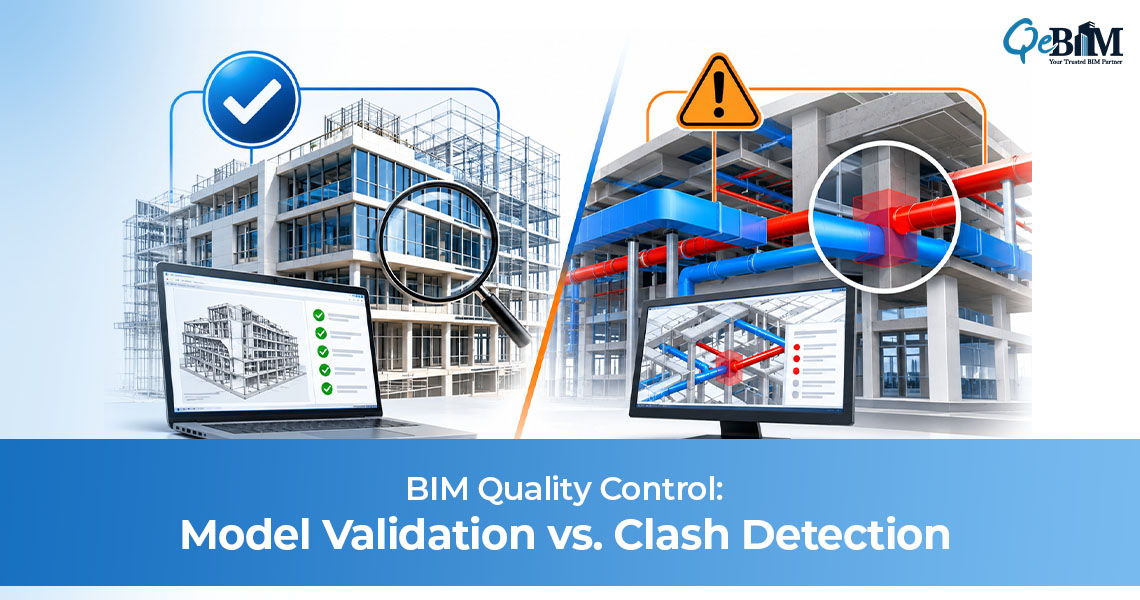
The fundamental difference is that validation examines whether a model is correctly developed, whereas clash detection examines whether its elements can coexist spatially without creating conflicts.
Why Are Both Processes Important in BIM Projects?
Relying exclusively on clash detection can leave significant model-quality issues undetected. A model may be free from geometric conflicts but still contain incorrect equipment specifications, missing parameters, or inconsistent classifications.
Similarly, a model can pass validation checks while containing physical conflicts between architectural, structural, and MEP elements.
Consider a commercial building project where the structural and MEP models are being coordinated.
During validation, the team discovers that several HVAC components have missing equipment identifiers and incorrect classification data. These issues are corrected to improve model completeness.
During clash detection, the same project reveals that a supply-air duct intersects a structural beam and a water pipe lacks the required insulation clearance.
Both findings require attention, but they address different aspects of project quality.
Integrating the two processes helps teams:
- Reduce design errors and avoid preventable site rework.
- Improve coordination between multiple disciplines.
- Maintain consistent model information throughout project stages.
- Support more reliable quantity take-offs and construction documentation.
- Improve communication between designers, consultants, and contractors.
- Strengthen confidence in models used for construction and facility management.
How to Integrate Model Validation and Clash Detection into a BIM Workflow?
For effective quality control, both processes should be incorporated into the BIM workflow rather than treated as final-stage checks.
Step 1: Establish Project Requirements
Define modelling standards, information requirements, LOD expectations, naming conventions, coordinate systems, and coordination responsibilities in the BIM Execution Plan.
Step 2: Validate Individual Discipline Models
Before combining architectural, structural, and MEP models, check each discipline model for geometric inconsistencies, missing parameters, duplicate elements, and incorrect classifications.
Step 3: Develop a Federated Model
Combine the approved discipline models using a common coordinate system. Verify positioning, orientation, units, and model alignment before running coordination checks.
Step 4: Perform Clash Detection
Develop a clash matrix to define the discipline combinations that require coordination checks. Establish appropriate tolerances and clearance requirements. Run the tests and group results according to location, system, and responsible discipline.
Step 5: Review and Resolve Issues
Not every detected clash represents a genuine design problem. BIM coordinators and discipline engineers should review the findings, eliminate false positives, prioritise critical conflicts, and assign corrective actions.
Step 6: Revalidate and Recheck Updated Models
After corrections, repeat relevant validation and clash tests. Maintain issue logs, revision records, and reports to confirm that previously identified problems have been addressed.
Selecting the Appropriate BIM Quality-Control Strategy
BIM model validation and clash detection should not be treated as alternative approaches, as both serve distinct yet complementary quality-control purposes. Both are complementary processes, and their application depends on the project stage, model maturity, information requirements, and coordination complexity.
During early design, model validation helps establish a reliable modelling foundation. As architectural, structural, and MEP models become more detailed, clash detection becomes increasingly important for identifying spatial conflicts. Both checks should continue as models are revised and progress towards construction.
Working with an experienced BIM Services Provider can help project teams establish consistent checking procedures, coordinate multidisciplinary models, and maintain quality across deliverables. Dedicated Clash Detection Services can further support structured interference checks, issue reporting, and coordination reviews.
Conclusion
BIM model validation and clash detection address two different but equally important dimensions of model quality. Validation ensures that models meet the required standards for geometry, information, and compliance, while clash detection identifies physical and clearance conflicts between building elements.
Neither process can replace the other. When integrated into a structured BIM quality-control workflow, they help project teams deliver more reliable models, improve multidisciplinary coordination, and minimise avoidable construction-stage complications.