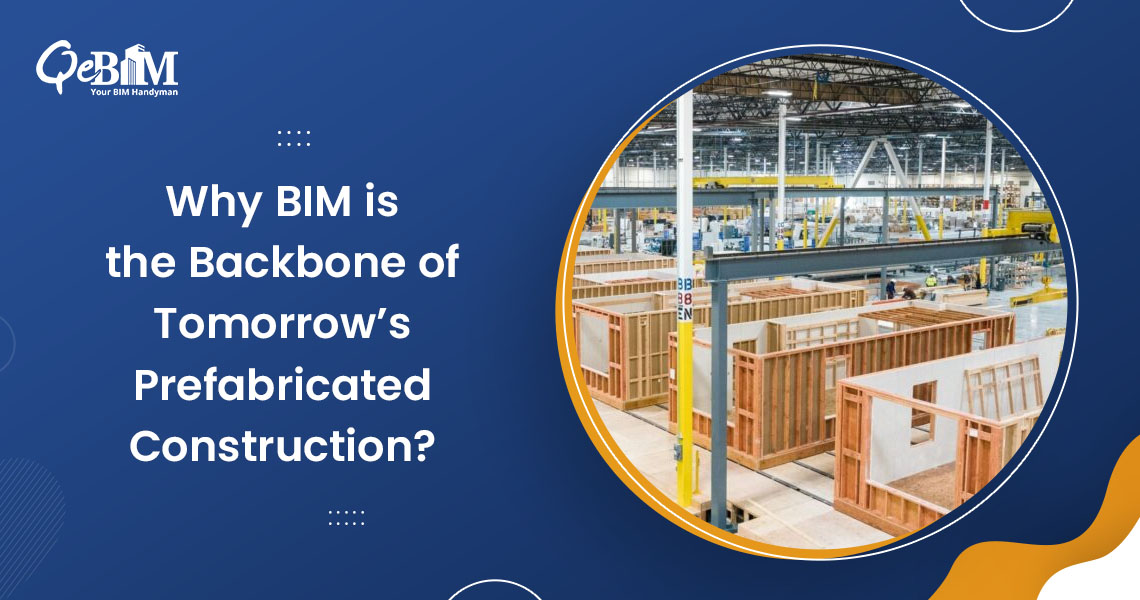
Prefabrication and modular construction are rapidly reshaping the global AEC landscape. As developers demand faster delivery, higher accuracy and reduced wastage, the industry is turning towards the digital technologies that eliminates the guesswork and maximizes the precision. At the core of this evolution lies BIM — a transformative force that is redefining how offsite components are designed, coordinated, manufactured and assembled.
Today, the leading BIM Services are pushing the boundaries of what prefabrication can achieve thereby enabling the construction teams to execute the projects with unmatched speed and efficiency. Let’s explore how this digital shift is streamlining the offsite construction workflows and what the future holds for this powerful combination.
Why BIM Is Critical to the Future of Prefabrication?
1) Data-Driven Design for Better Offsite Manufacturing
Prefabrication thrives on accuracy. Every panel, module and MEP element must be produced to the exact specifications. BIM provides a centralized model enriched with the intelligent data that drives the machine-readable fabrication drawings, CNC outputs and production schedules. This eliminates the manual errors and helps the manufacturing teams to work confidently with the precise dimensions, materials and tolerances thereby ensuring that the offsite components fit perfectly onsite.
Manufacturers using BIM-based workflows reports faster project delivery and reduced reworks, because the digital model integrates architectural, structural along with the MEP details right from the design stage.
2) Enhanced Coordination and Conflict-Free Modular Assembly
One of the biggest challenges in prefabrication is ensuring the seamless integration between the prefabricated components and the traditional construction elements. BIM enables various teams to work on the coordinated models where clashes are detected early.
The result?
- Fewer onsite adjustments
- Reduced reworks
- Smooth installation sequences
With BIM-driven coordination, modular units arrive perfectly aligned with the real-world site conditions, accelerating the overall assembly. According to one review, BIM can prevent up to 80% of design errors and omissions which drives around 11% cost savings and reduces the project timelines by around 25%.
3) Optimized Production Scheduling and Logistics
Timely manufacturing and delivery are key to the successful offsite workflows. BIM integrates with 4D (time) and 5D (cost + scheduling) simulations providing deeper insights into:
- Production sequencing
- Transportation planning
- Onsite crane path optimization
- Cost forecasting
This ensures prefabricated elements reach the site exactly when needed hence preventing the delays, idle labour and storage issues. According to the authors of a recent academic review, integrating BIM with the lean construction and modular manufacturing “produces value to the project team,” including improved productivity, reduced schedule durations, lower costs as well as the higher quality. (journalofindustrializedconstruction.com)
Moreover — beyond just design and build — advanced digital-twin frameworks propose AI-assisted resource leveling, real-time progress tracking and dynamic schedule adjustment based on the real world data. One recent example on a mid-rise project showed reductions in labor estimating by 43%, lowered overtime by 6%, and improved reliability for project-buffer utilization — all possible thanks to the BIM-driven predictive workflows.
4) Sustainability & Waste Reduction: Prefab + BIM for a Greener Future
Prefabrication is already known for minimizing the material wastage but BIM elevates this further by enabling the precise quantity take-offs and optimized cutting patterns even before the manufacturing begins.
Research comparing modular (prefabricated) versus conventional on-site construction has demonstrated that the modular construction can reduce overall material waste by as much as 83.2% in certain large structures.
Even for the smaller structures — where waste control is more challenging — reductions in the range of 80%+ have been observed under ideal modular-factory conditions. (MDPI)
Beyond waste, prefab + modular construction technologies helps in lowering the embodied carbon emissions. Some studies report 15–30% reduction in carbon footprint compared to the conventional cast-in-place buildings, depending on materials, building type and reuse/recycling strategies. (JETIR)
Furthermore, controlled factory environments enable the better energy management during the manufacturing (versus on-site operations).
Thanks to BIM’s precision, prefab components can also be designed for thermal efficiency, better insulation and durability — enhancing the building’s long-term energy performance.
5) Cost Savings, Speed Gains and Quality Improvements
Time and cost savings are among the most compelling reasons developers and contractors pursue prefab + BIM workflows. According to the industry data:
- Prefabricated construction techniques — when supported by the modular offsite workflows — can deliver the projects 20–50% faster than the traditional onsite construction. (pc.gov.au)
- Prefab + BIM workflows can also reduce the project costs by a significant margin: some sources cite as much as 20% cost savings, improved productivity and reduced labour needs. (BIM Services India)
- Maintenance costs over the building lifetime may also be lower due to higher precision, better finishes and controlled manufacturing leading to long-lasting and more durable buildings.
These savings — in time, money, waste and long-term performances make prefab + BIM workflows an increasingly attractive proposition for developers, especially for the multi-story residential blocks, hotels, schools and other repeatable typologies.
What the Future Holds: Robotics, AI & Digital Twins
The next decade will likely see even deeper integration of BIM with automation tools, robotics, AI-driven designs and digital-twin based building lifecycle management. Imagine:
- Robotic manufacturing of modular units — where BIM data is automatically fed to CNC machines, automated welders, 3D-printing or robotic panel assemblers, greatly reducing the manual labour and speeding up the production.
- AI-driven generative design for modular layouts — enabling real-time optimization of module size, orientation, structural efficiency and energy performance.
- Digital twins for remote monitoring and lifecycle management — once modules are assembled and building is commissioned, BIM-based digital twins can track building performance, maintenance needs, energy consumption and even guide retrofit or expansion work.
- IoT-enabled modules — where prefab units integrate sensors for environmental performance, energy use, occupancy thereby feeding the data back to the BIM-digital twin for analytics and predictive maintenance.
Such a future could revolutionize how the buildings are designed, constructed, maintained and eventually decommissioned enabling not just speed and cost efficiency but long-term sustainability, resilience and adaptability.
Why Choose a Forward-Looking BIM Company for Prefabrication?
Partnering with an innovative BIM Company rather than relying on the traditional workflows ensures that your prefabrication strategy is future-ready. A skilled BIM partner brings:
- Advanced 3D/4D/5D modelling and coordination capabilities, enabling the clash detection and construction sequencing long before the physical work begins.
- Fabrication-ready detailing, producing shop drawings, CNC/fabrication instructions and material take-off — reducing the manual drafting time and errors.
- Data-driven scheduling and logistics planning, optimizing production, transport and installation.
- Sustainability and waste management expertise which helps in minimizing the environmental impact while improving the cost efficiency.
- Capability to integrate the advanced technologies like digital twins, IoT and even AI/automation as your project or company scales.
For developers and contractors aiming to stay competitive in a rapidly evolving construction industry — especially in markets with increasing demand for speed, quality, sustainability, and cost control — such a partnership can deliver a strong return on investment from concept to installation.
Conclusion
The next chapter of prefabrication will be defined by how BIM continues to advance. From improved design accuracy and enhanced coordination to smarter scheduling, sustainability and AI-powered automation — BIM is transforming every stage of offsite construction. The numbers speak for themselves: reductions in waste of up to 80–83%, project schedule acceleration by 20–50%, cost savings nearly 20% and improved quality and durability.
As the industry continues to embrace the digital workflows, modular fabrication and BIM will no longer be optional advantages — they will become the standard for high-performance, efficient, sustainable construction. For companies and developers ready to embrace the future, BIM + prefabrication offers the most powerful pathway forward.
If you’re considering elevating your prefabrication workflows and adopting the next-gen digital construction practices, BIM is your most powerful ally and choosing the right BIM-enabled partner makes all the difference.