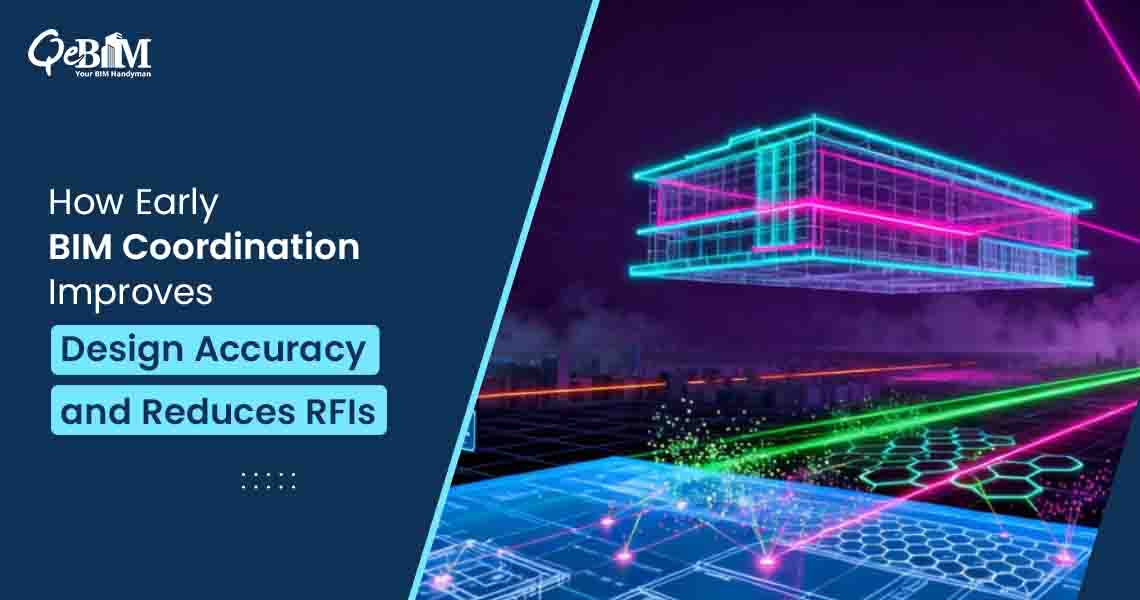
In complex AEC projects, RFIs (Requests for Information) and change orders are more than just the administrative hurdles—they are direct indicators of the coordination gaps, design misalignments and constructability issues. Studies across the large-scale commercial and infrastructure projects consistently shows that a significant percentage of RFIs and change orders originates long before the construction even begins, rooted in fragmented design coordination.
This is where early BIM coordination becomes a strategic advantage rather than a downstream problem-solving tool.
Understanding the Root Cause of RFIs and Change Orders
RFIs and change orders typically arise from:
- Gaps or inconsistencies in design documentation
- Interdisciplinary conflicts between architectural intent, structural systems and MEP layouts
- Undefined tolerances and unclear responsibilities
- Late-stage design changes due to constructability constraints
Traditionally, these issues surface during construction— when the cost of resolution increases exponentially
Industry data suggests:
- Design-related RFIs account for over 60% of total RFIs on the large projects
- Change orders can increase the project costs by 5–15% when the coordination issues are discovered late
Early BIM coordination shifts these discoveries upstream—where the resolution is faster, cheaper and less disruptive.
What Is Early BIM Coordination?
Early BIM coordination refers to the integration and alignment of all discipline models during the design and preconstruction phases, rather than just waiting for the construction documentation or site execution.
It involves:
- Coordinating architectural, structural and MEP models at defined Levels of Development
- Establishing spatial zones, system clearances and modeling standards early
- Running iterative clash detection and constructability checks before the drawings are issued
The goal is not just clash detection—but clash prevention through the informed design decisions.
How Early BIM Coordination Directly Reduces RFIs?
- Eliminates Ambiguity in Design Intent
Coordinated BIM models provide a single, shared source of truth. When dimensions, system routing and spatial constraints are resolved digitally, contractors no longer need to seek clarifications for missing or conflicting information.
Result:
- Fewer “design clarification” RFIs
- Reduced back-and-forth between site and design teams
- Resolves Interdisciplinary Conflicts Before Construction
Hard and soft clashes between the structure, services and architectural elements are among the top drivers of RFIs. Early coordination allows the teams to resolve:
- Duct vs beam conflicts
- Pipe slope vs ceiling height issues
- Equipment access and maintenance clearances
By resolving these in the model, RFIs related to “field conflicts” drops significantly.
- Improves Drawing Accuracy and Consistency
When coordinated models drive drawings, inconsistencies between the plans, sections and schedules are minimized. This reduces the RFIs caused by:
- Mismatched dimensions
- Conflicting elevations
- Discrepancies between the layouts and services
Contractors receive coordinated documentation that reflects the real-world build conditions.
How Early BIM Coordination Minimizes Change Orders?
- Detects Constructability Issues Before Procurement
Late-stage changes often occurs when the systems cannot be installed as designed. Early coordination allows the teams to validate:
- Installation sequencing
- Prefabrication feasibility
- Access and working space requirements
This prevents the costly changes after the materials are ordered or installed.
- Controls Design Changes Through Data-Driven Decisions
When the design alternatives are evaluated in a coordinated BIM environment, stakeholders can visually assess the impacts on cost, schedule and space before approvals.
This reduces:
- Reactive design changes during the construction
- Scope creep caused by overlooked system dependencies
- Enables Better Cost and Schedule Predictability
Each avoided clash or rework translates into measurable savings. Industry benchmarks indicates that early BIM coordination can:
- Reduce the change orders by up to 40%
- Improve the construction schedule reliability by 7–10%
These benefits compound on large, multi-discipline projects.
The Role of Standards, Tolerances and Workflow Definition
Early BIM coordination is most effective when supported by:
- Defined modeling standards and coordination matrices
- Clear responsibility zones for each discipline
- Agreed tolerance levels aligned with the fabrication and installation realities
Without these, even the detailed models can generate RFIs due to misaligned expectations.
Why Early Coordination Is a Strategic Investment?
Engaging BIM Coordination Services early in the project lifecycle enables the teams to move from the reactive problem-solving to proactive risk mitigation. Instead of managing RFIs and change orders as inevitable outcomes, teams can significantly reduce them by embedding coordination into the design process.
When supported by accurate BIM Modeling Services, early coordination ensures that the design intent, constructability and execution are aligned—long before the construction begins.
Conclusion
RFIs and change orders are not just construction-phase issues—they are symptoms of early-stage coordination gaps. By implementing the BIM coordination at the earliest stages of design, the project teams can identify conflicts, clarify intent and validate the constructability when changes are still inexpensive and manageable.
Early BIM coordination transforms BIM from a documentation tool into a decision-making framework, delivering measurable reductions in RFIs, fewer change orders and smoother project execution across the entire project lifecycle.