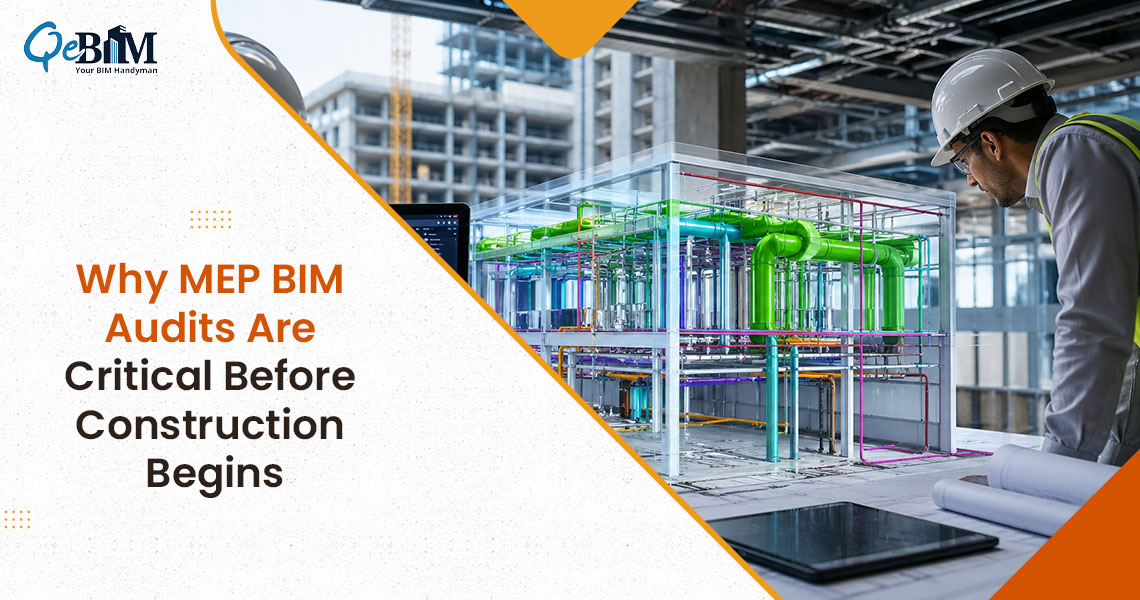
In today’s increasingly complex building environment, the margin for error is shrinking. Mechanical, Electrical and Plumbing (MEP) systems are no longer standalone elements—they are deeply interdependent, spatially constrained and critical to overall building performance.
A well-executed MEP BIM model can significantly reduce the risks, but only if it is rigorously audited before the construction begins.
An MEP BIM audit is not just a quality check—it’s a strategic validation process that ensures the constructability, coordination, compliance and performance.
Why MEP BIM Model Auditing is Critical?
Industry studies suggest that nearly 30–35% of construction rework is linked to the coordination issues and design conflicts. A large portion of these originates within the MEP systems due to their density and complexity.
Auditing helps:
- Detect clashes before they reach site
- Validate system performance and routing logic
- Ensure compliance with the project standards and codes
- Reduce costly on-site modifications
- Improves installation sequencing and constructability
Key Areas to Audit in an MEP BIM Model
- Model Integrity & Data Consistency
Start with the fundamentals:
- Are all systems modeled (HVAC, electrical, plumbing, fire protection)?
- Are naming conventions consistent across disciplines?
- Are parameters correctly assigned (flow rates, voltage, pipe sizes, etc.)?
Check for:
- Duplicate elements
- Unconnected systems
- Missing or incorrect metadata
A model with the inconsistent data can lead to major downstream errors in estimation, scheduling and facility management.
- Clash Detection & Coordination
Clash detection is at the core of any audit process.
Types of clashes to verify:
- Hard clashes (physical intersections)
- Soft clashes (clearance issues)
- Workflow clashes (sequencing conflicts)
Focus areas:
- MEP vs Structure (ducts through beams)
- MEP vs Architecture (equipment vs ceiling heights)
- Interdisciplinary clashes (pipe vs cable tray)
Advanced audits also evaluate clash severity and resolution responsibility, not just detection.
- System Routing & Constructability
A model may be clash-free but still not buildable.
Evaluate:
- Logical routing of ducts, pipes and conduits
- Accessibility for installation and maintenance
- Realistic spacing for supports, insulation and fittings
Questions to ask:
- Can this system be installed as modeled?
- Are there practical access points for valves, dampers, panels?
Constructability review bridges the gap between the design intent and site execution.
- Level of Development (LOD) Compliance
Ensure that the model aligns with the required LOD at the project stage.
- LOD 300: Design intent with approximate geometry
- LOD 350: Includes supports and clearances
- LOD 400: Fabrication-ready detailing
Mismatch in LOD can lead to:
- Incomplete fabrication data
- Errors in procurement
- Delays in shop drawing production
- Code Compliance & Standards Check
Verify adherence to:
- Local building codes
- Fire safety regulations
- HVAC standards (ASHRAE guidelines)
- Electrical safety norms
Also check:
- Minimum clearances
- Equipment placement regulations
- Pipe and duct sizing standards
Non-compliance at this stage can lead to the redesign approvals and project delays.
- Quantity Take-Off & BOQ Validation
Accurate quantities depend on the clean models.
Audit for:
- Correct element classification
- Accurate lengths, areas, and counts
- Elimination of redundant or placeholder elements
This directly impacts:
- Cost estimation
- Procurement planning
- Budget control
- Integration with MEP Shop Drawings
An audited BIM model should seamlessly transition into the fabrication and installation documentation.
Ensure:
- Model elements are detailed enough for shop drawings
- Fabrication tolerances are considered
- Spooling logic is feasible
This is where MEP BIM Services and MEP Shop Drawing Services intersects thus ensuring that the model is not just coordinated, but production-ready.
- Documentation & Audit Trail
A proper audit doesn’t end with the issue identification.
It should include:
- Detailed audit reports
- Markups with the issue categorization
- Responsibility matrix for resolution
- Version tracking for model updates
A structured audit trail ensures the accountability and continuous improvement.
Tools Commonly Used for MEP BIM Audits
- Autodesk Navisworks (Clash Detection & Coordination)
- Revit (Model validation and parameter checks)
- Solibri (Rule-based model checking)
- BIM 360 / ACC (Collaboration and issue tracking)
Best Practices for Effective MEP BIM Auditing
- Conduct audits at multiple project stages, not just pre-construction
- Use rule-based automated checks wherever possible
- Involve the multidisciplinary teams (designers, coordinators, site engineers)
- Prioritize high-risk zones (plant rooms, shafts, ceiling congested areas)
- Aligns audit outcomes with construction sequencing
Final Thoughts
An MEP BIM model is only as valuable as its accuracy, coordination and constructability. Auditing transforms it from a design artifact into a reliable construction asset.
In an industry where the delays and reworks directly impacts the profitability, a robust MEP BIM audit is not optional—it’s essential.
It’s no longer about whether an audit is needed—it’s about how comprehensive and rigorous it is before construction begins.