Introduction
In today’s fast-paced construction environment, steel structures form the backbone of complex commercial, industrial, and infrastructure projects. However, despite advances in design and fabrication, site modifications remain one of the most persistent challenges—leading to delays, cost overruns, and compromised quality.
A significant portion of these issues stems from the fragmented design workflows, lack of interdisciplinary coordination and discrepancies between the design intent and fabrication realities. This is where the coordinated steel models, powered by Structural BIM Services, are transforming the project delivery by minimizing the uncertainties before they reach the construction site.
Understanding Coordinated Steel Models
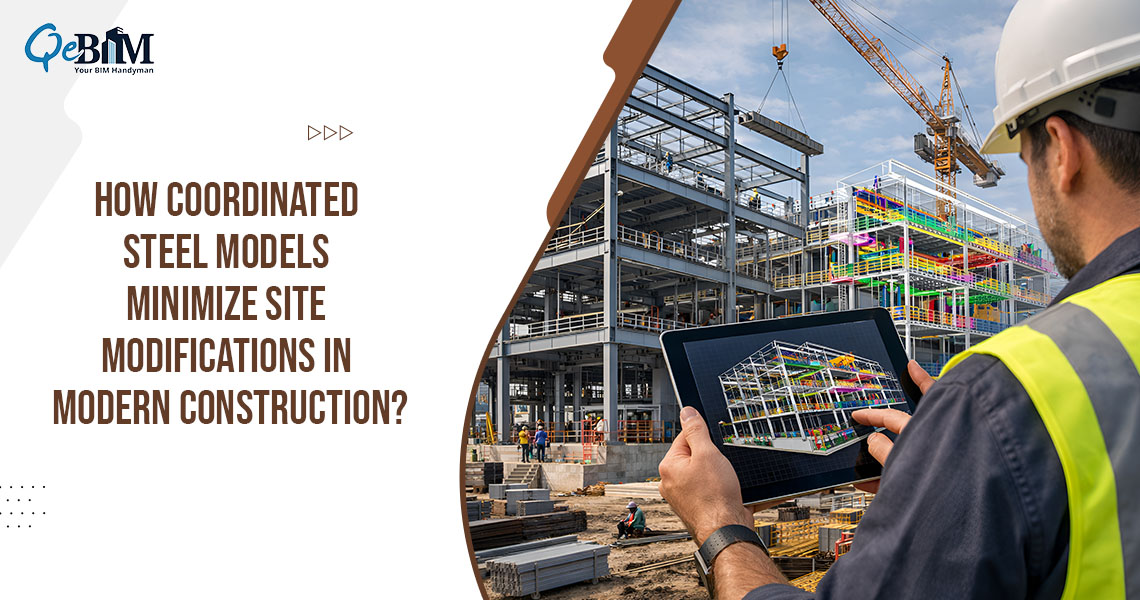
A coordinated steel model is a highly detailed, federated 3D representation of the structural steel system, integrated with the architectural, MEP and fabrication data. Unlike traditional 2D drawings, these models are:
- Data-rich and parametric
- Fabrication-aware (bolt sizes, weld types, connection details)
- Interdisciplinary (aligned with MEP and architectural systems)
- Continuously updated through the collaboration platforms
This level of integration ensures that all the stakeholders—engineers, fabricators and contractors—work from a single source of truth.
Why Site Modifications Occurs in Steel Projects?
Before understanding the solution, it’s critical to examine the root causes of the site modifications:
- Design-Clash Conflicts
Uncoordinated structural elements often clash with the HVAC ducts, cable trays or plumbing systems.
- Inaccurate Fabrication Details
Missing or unclear connection details can result in incorrect fabrication, requiring on-site adjustments.
- Tolerance Mismatches
Steel components fabricated off-site may not align due to cumulative tolerances not accounted for during design.
- Late Design Changes
Revisions during the construction phases forces reworks, especially when the coordination is not dynamically managed.
- Poor Communication Between Stakeholders
Disjointed workflows lead to misinterpretation of drawings and specifications.
According to industry reports, reworks can account for up to 5–15% of total construction costs, with a significant portion attributed to coordination failures.
How Coordinated Steel Models Eliminate Site Modifications?
- Advanced Clash Detection and Resolution
Coordinated models enables early-stage clash detection across structural and non-structural systems. Using clash detection tools, conflicts are identified and resolved virtually before the fabrication begins.
- Hard clashes (physical overlaps)
- Soft clashes (clearance issues)
- Workflow clashes (installation sequencing conflicts)
This proactive approach reduces the likelihood of on-site conflicts by over 80% in many BIM-driven projects.
- Fabrication-Ready Detailing
Steel models developed through the coordinated workflows includes precise detailing:
- Bolt placements and sizes
- Plate geometries
- Weld specifications
- Connection types (moment, shear, bracing connections)
This eliminates the ambiguity in shop drawings and ensures that fabricated components fits perfectly during the erection.
- Improved Tolerance Management
Coordinated models incorporates the real-world tolerances, accounting for:
- Fabrication deviations
- Erection tolerances
- Thermal expansion and load-induced deflections
By simulating these factors digitally, teams can pre-adjust the designs, significantly reducing the misalignment issues on-site.
- Seamless Integration with Fabrication Tools
Modern steel models integrates directly with the CNC machines and fabrication software through the formats like DSTV and IFC.
- Reduces the manual data entry errors
- Ensures the consistency between the design and fabrication
- Speeds up the production cycles
This digital continuity ensures that what is designed is exactly what gets fabricated.
- Enhanced Construction Sequencing (4D BIM)
Coordinated models can be linked with the project schedules to simulate erection sequences:
- Identifies access constraints
- Prevents installation conflicts
- Optimizes crane usage and logistics
This minimizes the need for rework caused by the sequencing errors.
- Real-Time Collaboration and Updates
With cloud-based platforms, coordinated steel models allows:
- Real-time updates across the teams
- Version control and audit trails
- Instant communication of design changes
This ensures that all the stakeholders are aligned well thus reducing the risk of outdated information leading to the site errors.
Quantifiable Benefits
Projects leveraging the coordinated steel models and BIM Coordination Services consistently reports:
- Up to 60% reduction in RFIs (Requests for Information)
- 30–50% decrease in rework costs
- Improved installation accuracy by over 90%
- Shortened project timelines by 10–15%
These metrics highlights the direct impact of coordination on both cost efficiency and project delivery.
Real-World Application Example
In a large-scale commercial project, coordinated steel modeling identified over 2,000 clashes between structural beams and MEP systems during the preconstruction phase. By resolving these digitally:
- Fabrication errors were eliminated
- On-site welding adjustments were reduced by 70%
- Project completion was accelerated by 3 weeks
This demonstrates how early coordination translates into tangible on-site savings.
The Strategic Advantage
Coordinated steel models have evolved beyond a technical upgrade—they are now a critical strategic requirement. As projects become more complex and timelines more aggressive, the ability to predict and resolve issues before construction begins defines project success.
For contractors and developers, investing in coordinated modeling means:
- Reduced risk exposure
- Greater cost predictability
- Enhanced build quality
- Stronger client satisfaction
Conclusion
In an industry where even minor errors can cascade into major delays, coordinated steel models provide a powerful solution to one of construction’s most persistent challenges—site modifications.
By bridging the gap between the design, fabrication and construction, they ensure precision, efficiency and reliability at every stage of the project lifecycle. As digital construction continues to evolve, coordinated modeling will remain at the core of delivering smarter, faster and more resilient steel structures.