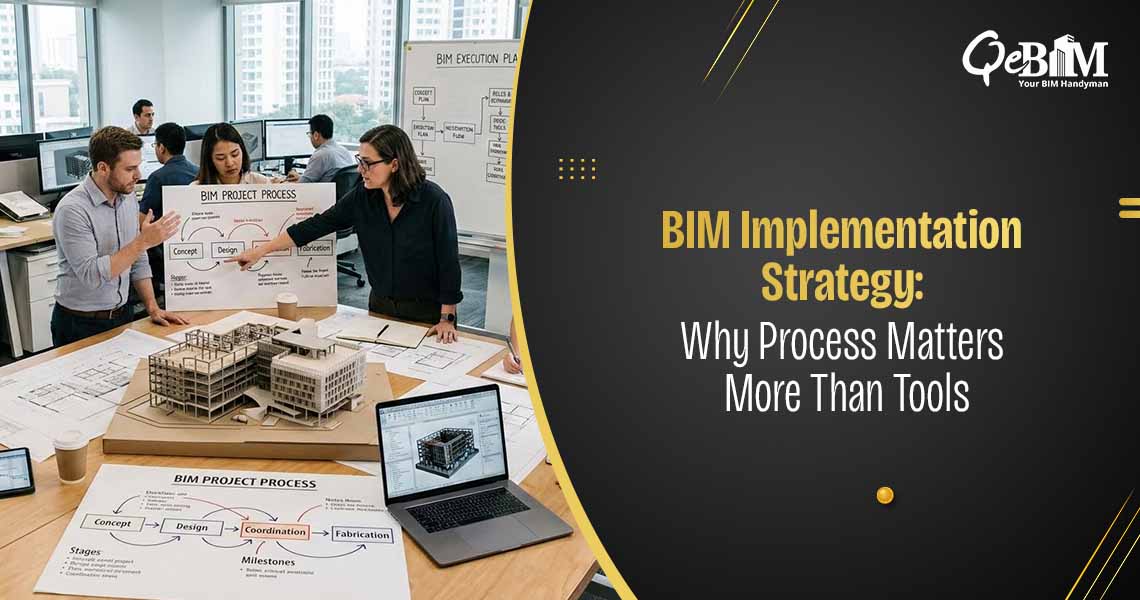
When organizations decide to adopt BIM, the first question is usually:
“Which software should we invest in?”
It’s a logical starting point. After all, BIM is technology-driven.
But after working across multi-disciplinary projects globally, one reality becomes very clear:
BIM success depends far more on process maturity than on software capability.
The most advanced tools cannot compensate for undefined workflows, inconsistent data standards or unclear responsibilities.
The Software Illusion in BIM Implementation
Today’s BIM platforms are incredibly powerful. They offer:
- Intelligent 3D modeling
- Automated clash detection
- 4D scheduling
- 5D cost integration
- Data-rich asset management
Yet, global construction studies consistently show that nearly 70% of large projects experience delays or cost overruns.
The issue isn’t the absence of technology —
it’s the absence of a well-defined, structured process.
You can use the most sophisticated platform available, but if:
- Naming conventions differ across teams
- Model versions aren’t controlled
- LOD expectations are unclear
- Coordination cycles are irregular
- There is no defined BIM Execution Plan (BEP)
The result is friction instead of collaboration.
BIM Is a Delivery Framework — Not Just a Tool
Many organizations treat BIM as a modeling upgrade. In reality, it is a project delivery methodology.
A capable BIM Company recognizes that software is just one part of a broader ecosystem that also includes:
- Governance
- Workflow documentation
- Quality assurance protocols
- Data management standards
- Accountability structures
Without these, BIM becomes a 3D drafting exercise — not a coordination strategy.
- The Power of a Structured BEP
A BIM Execution Plan (BEP) defines:
- Roles and responsibilities
- Level of Development (LOD) milestones
- Model exchange formats
- Collaboration platforms
- Approval workflows
When the BEP is actively followed — not just created for compliance — it transforms project clarity.
Without it, the teams interpret requirements differently thus leading to avoidable coordination gaps.
- Defined Roles Prevent Coordination Chaos
One of the biggest reasons BIM initiatives fail is unclear ownership.
Who is responsible for clash resolution?
Who validates model health?
Who ensures parameter consistency?
Who controls version releases?
When these responsibilities are undefined, even the best software produces reactive outcomes instead of preventive coordination.
Process defines accountability. Software simply executes the instructions.
- Standardization Ensures Model Reliability
A BIM model is only as reliable as the standards that support it.
Successful BIM teams establish:
- Family libraries and parameter controls
- File naming conventions
- Layer and classification standards
- QA/QC checkpoints
- Model health audits
Organizations offering professional BIM Services knows that the consistency in inputs directly determines the reliability of outputs.
Without structured standards, models become heavy, inconsistent and difficult to federate.
- Coordination Is a Cycle — Not an Event
Clash detection is often misunderstood as a one-click solution.
In reality, effective coordination follows a disciplined loop:
- Discipline modeling
- Internal quality checks
- Federated model integration
- Clash review meetings
- Resolution tracking
- Model update and revalidation
When this becomes a repeatable process, coordination becomes predictable.
Without it, teams simply “run clash detection” and responds to the issues too late.
Process Is What Drives BIM ROI
When BIM is process-led, organizations see measurable impact:
- Fewer RFIs
- Reduced reworks
- Lower site conflicts
- Faster approvals
- Improved cost predictability
- Higher client confidence
Software enables modeling.
Process enables performance.
Technology Changes. Process Scales.
Software evolves every year. New versions release. Features improves.
But a mature BIM process:
- Scales across projects
- Works across geographies
- Integrates with the new tools
- Builds internal capability
- Creates long-term organizational value
Companies that focus only on tools struggles with the consistency.
Companies that focus on process builds competitive advantage.
The Leadership Reality
From an operational perspective, BIM success requires:
- Executive alignment
- Cross-discipline collaboration
- Continuous training
- Process audits
- Performance measurement
BIM is not an IT upgrade.
It is an operational transformation.
Final Thought
If your BIM implementation isn’t delivering expected outcomes, don’t start by switching software.
Start by asking:
- Do we have documented workflows?
- Are responsibilities clearly defined?
- Is quality control embedded in the modeling cycle?
- Are we measuring coordination performance?
- Is our BEP actively implemented?
Because in BIM, the difference between inefficiency and excellence is rarely the tool.
It’s the process.