Introduction
BIM coordination is not a one-time task—it is a structured, phase-wise process that aligns the architectural, structural and MEP systems throughout a project’s lifecycle. A well-defined BIM coordination timeline ensures the constructability, clash avoidance and seamless information exchange from concept to facility operations.
Studies shows that over 70% of construction conflicts originates from the poor coordination during the early design stages thus leading to costly reworks and schedule overruns. By implementing the BIM Coordination Services across all the project phases, project teams can proactively manage the design intent, spatial conflicts and sequencing challenges—long before they impacts the site.
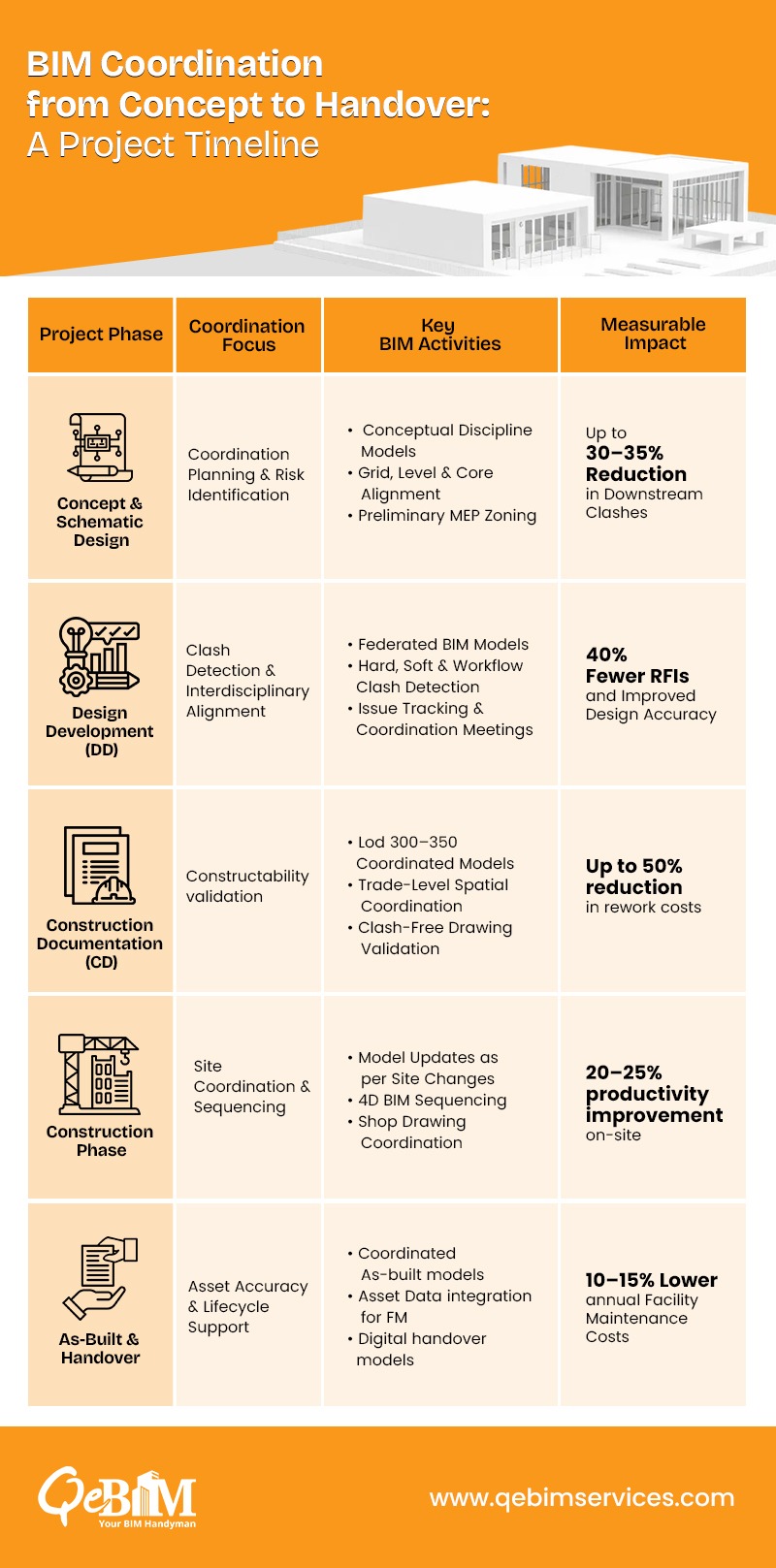
Phase 1: Concept & Schematic Design
Objective: Establish coordination foundations
- Creation of discipline-specific conceptual models
- Alignment of grids, levels and core layouts
- Preliminary MEP zoning and system routing strategies
- Identification of high-risk coordination zones
Impact:
- Early-stage BIM coordination can reduce the downstream clashes by up to 30–35%
- Enables informed design decisions with minimal redesign
Phase 2: Design Development (DD)
Objective: Detect and resolve the interdisciplinary conflicts
- Integration of architectural, structural and MEP models
- Clash detection (hard, soft and workflow clashes)
- Coordination meetings with issue tracking and resolution logs
- Model refinement to LOD 300
Impact:
- Projects using BIM coordination at DD stage report up to 40% fewer RFIs
- Improves the design reliability and stakeholder confidence
Phase 3: Construction Documentation (CD)
Objective: Ensures constructible, clash-free models
- Detailed BIM models aligned with the construction drawings
- Trade-level coordination and spatial optimization
- Model updates based on approved design changes
- Final coordination sign-off prior to construction
Impact:
- BIM-coordinated CD sets can reduce the rework costs by up to 50%
- Enhances the drawing accuracy and constructability
Phase 4: Construction Phase
Objective: Supports the site execution and sequencing
- Ongoing coordination updates reflecting the site conditions
- 4D BIM integration for construction sequencing
- Clash resolution based on the shop drawings and RFIs
- Coordination support for prefabrication and modular construction
Impact:
- BIM-driven coordination improves the construction productivity by 20–25%
- Reduces the on-site clashes and trade interferences
Phase 5: As-Built & Facility Handover
Objective: Delivers accurate digital assets for operations
- Creation of coordinated as-built BIM models
- Asset data integration for facility management
- Validation of installed systems against coordinated models
- Digital handover for FM and lifecycle management
Impact:
- BIM-enabled handover can reduce the facility maintenance costs by 10–15% annually
- Improves long-term asset performance and operational efficiency
Conclusion
A structured BIM coordination timeline transforms the project delivery from reactive problem-solving to proactive decision-making. When coordination is embedded across all phases—from early design through handover—projects experience fewer clashes, faster approvals, and significantly reduced rework.
By leveraging BIM Coordination Services strategically throughout the project lifecycle, AEC teams can achieve the predictable outcomes, improved collaboration and higher-quality builds—on time and within budget.